The Lights Stay On: Queer Museum Lates and the Art of the Slow Friday
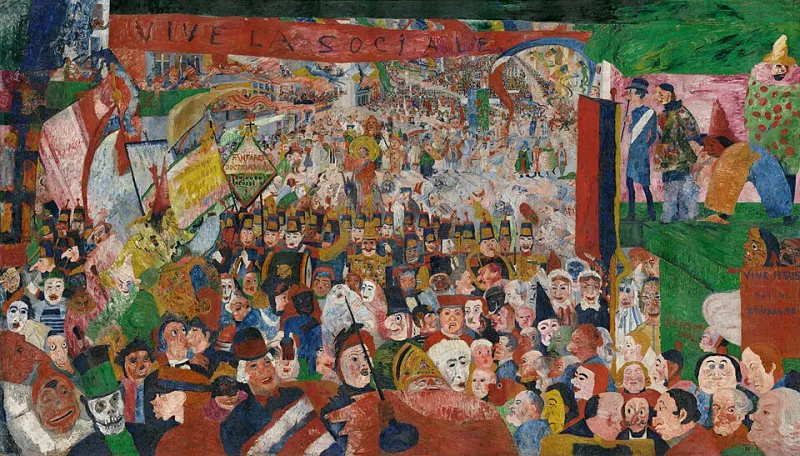
Photo: James Ensor, Public domain, via Wikimedia Commons
The last tour of the evening has ended and the room hasn't emptied. A dozen people are still stood around a vitrine in a Manchester gallery, arguing — fondly, at volume — about whether a particular Victorian silhouette reads as butch or just badly lit. Somewhere behind them a zine table is being restocked. There is no DJ. There is, crucially, no sticky floor.
This is a queer museum late, and it has quietly become one of the better Friday nights in the UK. Not instead of the club — alongside it. A place to go before, after, or entirely without.
How the late became the night out
Museum lates aren't new. Tate's have been running for years, the V&A has done them, and pretty much every major civic collection in the country has tried a version of "open till 10, licensed bar, some music." What's shifted in the past few years is the queering of the format — not just a rainbow flag on the flyer, but programming built around queer artists, queer archives and, increasingly, queer sociality.
In Glasgow, that's meant after-hours events tied to GoMA and the CCA that treat the gallery as a sitting room. In Manchester, the Whitworth and the Science and Industry Museum have both hosted late openings with zine tables, soft seating and performances that don't require you to stand in a crowd of four hundred to see them. In London, the Wellcome and the Barbican have leaned into the model of the "slow event" — you can arrive alone, leave alone, and still have spoken to six people.
"The brief was never 'make it a club'," says a programmer at a North West gallery who's been running lates since the before-times. "It was: what if we stayed open for the people who can't do clubs? Or don't want to? Or are skint? Or are newly out and need somewhere with a cloakroom and a fire exit?"
What actually happens at 8.45pm
The shape varies, but the rhythm is recognisable. Early evening is tours and talks — sometimes a curator doing a queer reading of a collection that has never been framed that way. Mid-evening is the noisy bit: performances, short films, a DJ in a corner of the atrium, a bar doing £4 cans. Then, from about nine, the late goes soft. The lights drop in one room, the seating comes out, the zine swap starts, and the whole thing becomes something closer to a living room.
That last bit is the point. "I go for the bit after the programme," says Sam, 34, who's been to lates in both Manchester and London. "The actual event is fine. It's the forty minutes afterwards, when nobody's performing and everyone's just milling about, that I've made friends at. It's the only place I've ever been chatted to by a stranger where the opening line wasn't about my appearance."
The quiet corners matter more than they sound. For anyone who's neurodivergent, sober, chronically ill, broke, or simply tired of being perceived, a large cultural building at night — with seating, toilets, water, and no expectation to dance — is a radically hospitable environment. Several of the people I spoke to described lates as the only cultural events they can attend without a recovery day afterwards.
Now the difficult bit
Here's the tension. Museum lates are cheap to put on relative to a club night, they generate good press, and they let institutions tick the community box without altering their core programme. That's the pinkwashing risk in a nutshell: a Friday in February, a queer artist on the panel, a lanyard, and nothing else changes for the other 364 days.
"I've done the February gig," says an artist who's performed at three lates in the past two years. "You're brought in as the diversity content, you're paid a fee that covers the train and not much else, and the institution gets to say it's engaged with the community. Meanwhile the permanent collection still describes us in the past tense."
Others are more generous. A Glasgow-based curator argues the lates have done real internal work — they've pushed acquisitions, changed interpretation panels, and created a route for queer staff to be visible in their own building. "It's a wedge," she says. "Not the whole door. But a wedge."
The test, everyone agreed, is what happens between the lates. Is there paid community advisory work? Are queer artists commissioned for the main programme, not just the late? Is the building genuinely accessible at 9pm — lifts, gender-neutral toilets, a quiet room that isn't a corridor? And is anyone on the door trained to handle a drunk bloke who's wandered in from the pub next door?
The Friday-night case for it
The case for the late, though, doesn't rest on institutional virtue. It rests on the fact that it's a good night out. You can go with one friend. You can go alone. You can drink or not. You can wear whatever. You can leave at nine and be home by ten, or stay till closing and walk to the last bus with a stranger who's just told you about a book you need.
That's not a consolation prize for people who can't handle the club. It's a different thing entirely — and for a lot of queer people, in a lot of UK cities, it's the thing that fits.
"The last tour ends and everyone sort of exhales," the Manchester programmer says. "That's my favourite bit of the job. The bit where the event is over and the room is still full."
Check your local gallery's listings — most UK lates are free or under a tenner, and the good ones don't make you book a slot.