The Fixer Is the Point: Why Queer Film Clubs Are Choosing Red Light Over Spotlight
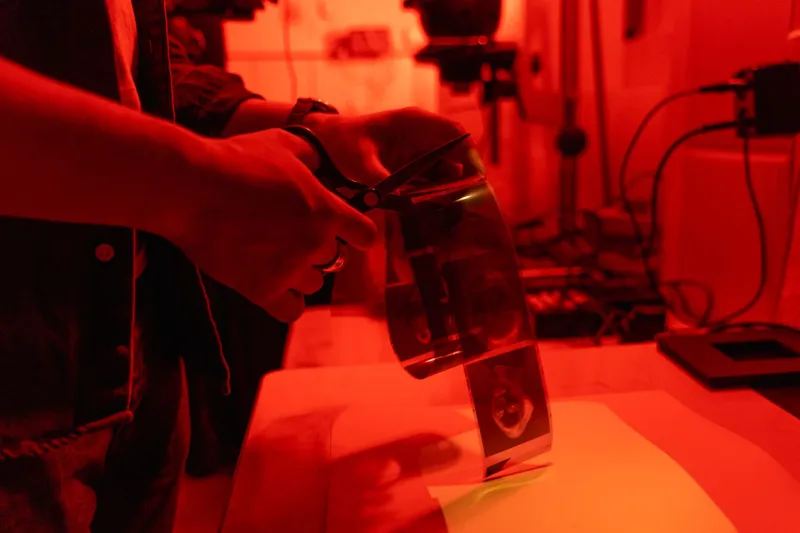
There is a particular kind of quiet that settles in a darkroom after the door clicks shut. It is not the hush of a library or the awkward silence of a lift. It is a working quiet: the slosh of developer, the tick of a timer, someone whispering that they think they have overexposed the whole roll. On a Friday night in a basement in Leeds, a dozen people are gathered around trays of chemicals rather than cocktails. Nobody is dressed to be looked at. Nobody is filming it for later. The red bulb is doing all the lighting, and it is doing just fine.
This is the unlikely nightlife of the queer darkroom club. Across the UK, from borrowed studios in south London to community photography spaces in Manchester, Glasgow, Bristol and Leeds, queer-run analogue meetups are filling a gap that apps and club nights have both failed to fill. They are part workshop, part social club, part gentle intervention against the idea that every evening has to be optimised, documented and performed. In 2026, the hottest ticket in some cities is not a DJ booth. It is a film dryer and a kettle.
A different kind of Friday night
The format is simple enough. You bring a roll of film, or you bring nothing at all and use a roll someone has donated. You learn to load a developing tank without wrecking it. You stand in the dark and count seconds. You learn that agitation is not a metaphor. Later, you crowd around a contact sheet and point at the frames that worked and the frames that absolutely did not. There are biscuits. There is tea. There is usually someone in the corner quietly explaining why their camera cost £12 from a charity shop and why that is the whole point.
What makes these sessions feel queer is not a playlist or a flag on the wall, although both turn up. It is the ethic. The darkroom is a space where you cannot fake it. You cannot filter your way out of a bad exposure. You cannot scroll past the bit where you made a mistake. You have to be present, hands wet, eyes adjusting, willing to learn in front of other people. For a community that has spent years being told to curate itself into something palatable, that is oddly freeing.
Why film, why now
There is an obvious irony in queer people retreating to analogue photography at a time when our social lives are mediated by apps. But the irony is the point. Apps ask you to sell yourself in a grid. Darkrooms ask you to slow down and see what is actually there. One is a performance of desirability; the other is a practice of attention. In a red-lit room, nobody is swiping. Nobody is checking who viewed their story. The phone stays in the bag because the chemicals do not care about your engagement metrics.
The tactile nature of it matters too. Queer life is often abstracted into discourse, into algorithms, into arguments that happen in text boxes. Film is stubbornly physical. You can hold a negative up to the light. You can smell the fixer. You can make a print with your own hands and give it to someone because you think they looked good in that frame. That is not a small thing. It is a way of making culture that does not require a platform, a brand deal or a blue tick.
The etiquette of the red light
Community darkrooms run on trust, and trust needs rules. The good sessions make those rules explicit without making them heavy. Ask before you look at someone else's negatives. Do not open the door when the sign says not to. Share the chemicals. Clean the tongs. If you ruin a print, say so and move on. If someone else ruins a print, do not make it a thing. The red light is not a cloak of invisibility; it is a shared condition. Everyone is a bit clumsy in it.
That etiquette extends beyond the technical. Queer darkroom clubs tend to be clear about consent, about access, about not assuming anyone's experience level or pronouns. Some sessions are for beginners only. Some are quiet sessions. Some have a no-camera rule for the first hour so people can just settle in. The result is a night out that feels less like a test and more like a practice. You are allowed to be bad at it. You are allowed to be new.
From contact sheet to zine table
The darkroom is only half the story. The other half is what happens when the prints dry. Queer analogue meetups are increasingly connected to zine-making, small presses and self-publishing. A session might end with a pile of contact sheets on a table and a loose plan for a collaborative zine. Someone has a scanner. Someone else knows a risograph studio. Another person has a staple gun and strong opinions about page order. It is chaotic, low-budget and deeply generative.
This is where the scene starts to look like infrastructure rather than a hobby. Community darkrooms are not just nice rooms with red bulbs. They are spaces where people learn to document their own lives, their own parties, their own protests. They are places where a young trans photographer can make a portfolio without paying studio rates. They are places where a dyke with a disposable camera can discover that their eye is worth taking seriously. The prints that come out of these rooms are not always technically perfect. They are alive.
The soft infrastructure
None of this happens by magic. Darkrooms need ventilation, running water, safe chemical disposal and someone willing to hold the keys. They need funding and accessibility and a venue that does not freak out about the words queer and community in the same sentence. The sessions that are thriving in 2026 are usually the ones plugged into wider networks: arts charities, LGBTQ+ community centres, sympathetic universities, pub back rooms that have been persuaded to host a drying rack.
That makes them fragile, but also hopeful. The queer darkroom club is not trying to compete with the club night. It is offering something adjacent: a place to be together without being watched, to make something slowly, to leave with a print and a phone number rather than a hangover and a vague sense of dread. It is a night out for people who are tired of nights out. It is a room where the light is red, the stakes are low and the fixer is, genuinely, the point.
If you want to find one, start with the queer arts newsletters, the community noticeboards and the photography collectives in your city. Ask in the group chat. Bring a roll of film you have been meaning to develop since 2024. Wear something you do not mind splashing. And do not worry about being good at it. The darkroom has seen worse.