The Lamp Is Buggered. Come In Anyway.
On a damp Saturday morning in November 2026, the queue outside a church hall in Leeds is less a queue than a loose huddle of people clutching carrier bags. Inside one bag: a lamp with a frayed flex. Inside another: a pair of jeans with a split seam. Inside a third: a kettle that has, in the owner’s words, “given up on life”. By noon, the lamp will work, the jeans will be patched, and the kettle will probably still be buggered — but nobody will be pretending that was the only point.
This is a queer repair café: part skill-share, part social club, part soft landing. The format is simple. You bring something broken. A volunteer helps you take it apart, diagnose it, and — with luck — fix it. You stay with your object. You learn a little. You drink tea. You talk. In 2026, as the cost of living keeps squeezing and public spaces for LGBTQ+ people keep shrinking, that combination feels less like a nice idea and more like infrastructure.
A kettle is a conversation starter
The sessions I’m talking about aren’t always branded as LGBTQ+ only. Some are ordinary repair cafés with queer volunteers and a deliberately welcoming ethos. Others are explicitly trans and queer spaces, advertised through community centres, group chats and the kind of word-of-mouth that still works better than any poster. The point is not to gatekeep a soldering iron. The point is to make room at the table for people who have learned to expect a certain amount of friction when they walk into a room.
At a monthly session in Bristol, I watch a volunteer named Jules talk a nervous regular through replacing a plug. Jules is trans, in their fifties, and has the calm of someone who has explained the same thing many times without ever making you feel stupid. “People come in apologising,” they say. “Sorry for wasting your time. Sorry it’s only a lamp. Sorry I don’t know the words. I tell them: the lamp is the excuse. The time is the point.”
That line stays with me. Repair cafés are often framed as environmental projects — keep stuff out of landfill, fight planned obsolescence, learn to resist the throwaway economy. All true. The Repair Café movement started in Amsterdam in 2009 and has since spread across the UK, with volunteers fixing everything from toasters to teddy bears. But the queer sessions I visit are less interested in lecturing you about carbon footprints than in offering a particular kind of hospitality: the kind where you are allowed to not know things, to be skint, to be newly out, to be having a bad week, and still be useful company.
Hospitality, not heroics
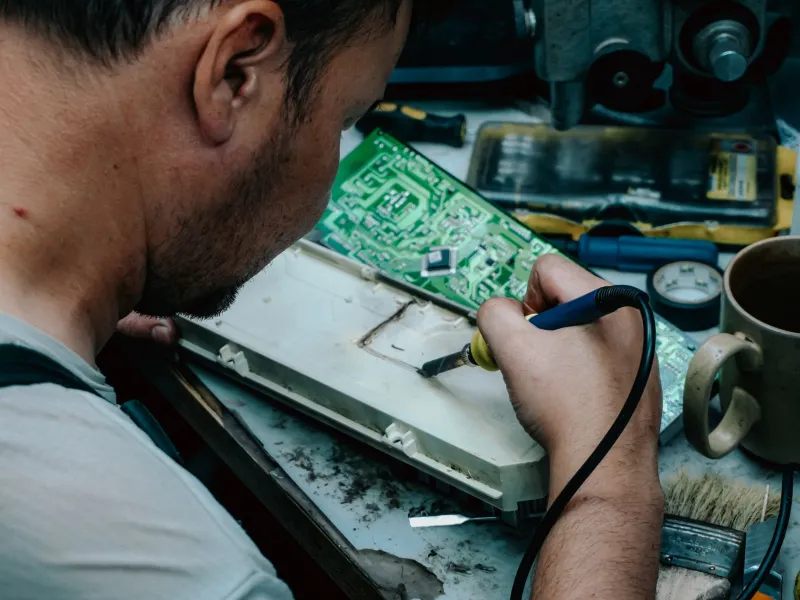
Mara runs a queer repair club in Leeds that meets on the second Saturday of the month. She is clear that the sessions are not a drop-in fix-it shop. “We’re not a service,” she says. “We’re neighbours with soldering irons. You sit with your thing, you learn how it works, and if it can’t be fixed, you leave knowing why. That matters. People deserve an explanation, not a pat on the head.”
There is no sign-in sheet that asks for pronouns, though there is a badge table if you want one. No one quizzes you on your identity. The queerness is in the texture: the way people introduce themselves, the way a volunteer asks before touching your stuff, the way someone notices you’re struggling with a tiny screw and pulls up a chair without making a thing of it. It is practical mutual aid with the emphasis on mutual. You are not a case. You are a person with a broken lamp and a Saturday morning to spare.
That low-pressure setup matters for trans and queer people in particular. So many spaces ask you to perform confidence before you’ve even hung up your coat. Repair cafés ask you to bring a broken object and a bit of patience. The social contract is refreshingly small. You don’t have to be good at DIY. You don’t have to be out. You don’t have to have a broken thing — though it helps.
Where to take your broken things
The geography of this scene is patchy but growing. In 2026, you’ll find queer-friendly repair sessions tucked into community centres, church halls, bike workshops and LGBTQ+ venues. Leeds has a monthly Saturday session that feels like a cross between a workshop and a kitchen table. Bristol’s trans-led fix-it afternoons rotate between spaces, which keeps them nimble and slightly secretive in the way that good community things often are. Glasgow has a solder-and-sew evening that began as a trans mutual-aid group and still runs on that energy. Manchester’s queer community centre hosts a repair table on open days, and London has a handful of sessions where the volunteer rota reads like a guest list for the best house party you’ve ever been to.
The best way to find one is still the old-fashioned way: ask around, check Repair Café UK’s network, follow local LGBTQ+ listings, and look for the phrase “all welcome” with actual detail behind it. If there isn’t one near you, the network will help you start one. You need a room, a few volunteers, some PAT-tested equipment, and a willingness to let the first session be a bit chaotic. That’s it. That’s the model.
The politics of a second life
What gets fixed isn’t only objects. A regular named Priya tells me she came to a Glasgow session with a broken hairdryer and left with three phone numbers and a standing invitation to a film night. “I’d been in the city six months and hadn’t really met anyone,” she says. “I thought I was going for the hairdryer. I was going for the company.”
That is the quiet radicalism of the queer repair café. It refuses the idea that care has to be grand or formal or funded by a council that may not exist next year. It says: we can mend things together, here, with what we’ve got. It says: your stuff is worth mending, and so are you. It says: bring the lamp. Bring the kettle. Bring the thing you’ve been meaning to throw out. The worst that happens is it stays broken. The best is that you don’t.