Boots, Bants and Belonging: The Queer Ramblers Taking Back the Trail
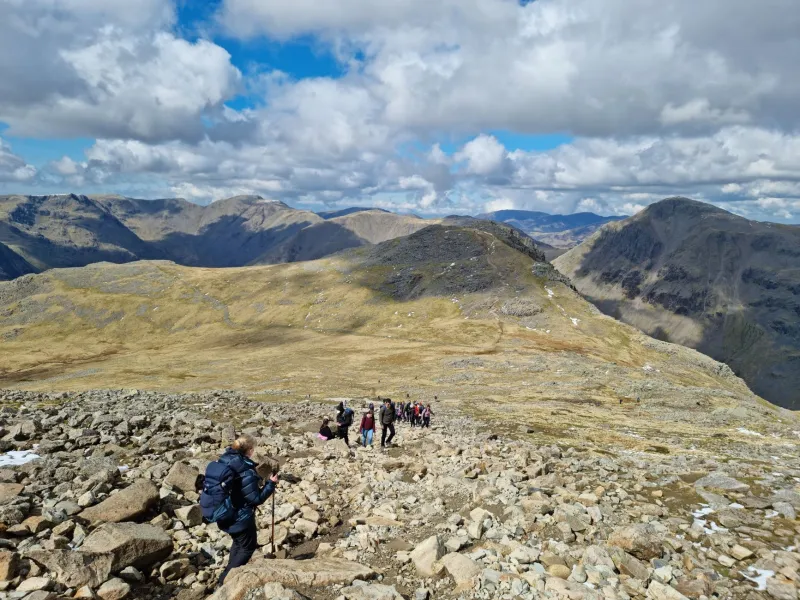
The first thing you notice on a queer ramble is the pace. Nobody is trying to win. On a bright Saturday in the Peak District, a group of about twenty walkers spreads along a muddy path, chatting in twos and threes, stopping whenever someone wants to take a photo of a particularly good mushroom. At the back, the organiser waits by every stile. Nobody gets left behind. That is the whole point.
Britain's countryside has a complicated reputation for LGBTQ+ people. The postcard version—cream teas, stone walls, a pub with a fire—can be lovely. It can also be a place where you scan a room before you hold hands, where the only other queer people you see are on a city-bound train. Walking groups are changing that, not by pretending rural Britain is perfect, but by showing up in numbers and making space.
The view from the back of the group
Sam, who runs Peak Out, started the group after moving to Sheffield and realising that most queer social events were centred on bars. 'I love a pub,' they say. 'But I also love being outside, and I wanted a way to combine the two without it being a big performance.' The group now runs monthly walks across the Peak District, graded from easy to moderate, with car shares from Sheffield and Manchester.
In Scotland, Ewan helps organise Queer Hikes Scotland. He says the group attracts a real mix: experienced hillwalkers, complete beginners, people who haven't been on a proper walk since school. 'The barriers are often practical,' he explains. 'Do I have the right boots? Will I hold people up? Will I be the only queer person in the pub afterwards?' The group answers those questions in advance, with route notes, pace guidance and a firm no-drop policy.
Nadia, from Queer Ramblers Bristol, plans routes around train stations and bus stops rather than car parks. 'A lot of rural access assumes you drive,' she says. 'We try to make it possible without a car, or we match people up for lifts. It sounds boring, but transport is a queer access issue.'
A short history of queer outdoors culture
Queer outdoors culture isn't new. The Gay Outdoor Club has been organising walks and weekends since the mid-1970s, carving out space for LGBTQ+ people to meet away from the city. In the 1980s and 1990s, walking groups offered a quieter kind of community—less visible than a Pride march, but no less important. Some of those groups are still going. The new wave is simply building on that history, with a more explicit focus on inclusion across gender, race, disability and class.
The countryside has never been politically neutral. Access to land, public transport and leisure time are all unevenly distributed. Queer walking groups don't solve that, but they do challenge the idea that rural space belongs only to a certain kind of person. A group of LGBTQ+ people on a moor is a small, ordinary act of reclamation.
The practical stuff: lifts, paces and pub stops
The best groups are obsessive about the boring details. They publish route lengths and ascent. They say whether there are toilets, stiles or livestock. They name a meeting point and a backup plan. They make it clear that turning back is allowed. And they check whether the pub at the end is actually welcoming, rather than assuming a rural boozer will be fine.
That care matters. For people who have felt out of place in the countryside, a well-organised walk can be the difference between staying home and getting the train. It can also be silly. Expect bad jokes, shared sandwiches, someone's dog stealing a flapjack and a group photo in which nobody looks at the camera.
Walks to try in 2026
- Peak Out, Peak District – monthly walks from Sheffield and Manchester, easy to moderate, with car shares. Check socials for dates and kit notes.
- Queer Hikes Scotland – seasonal meets around Glasgow, Edinburgh and the Highlands. Routes are graded, and slower walkers are never left behind.
- Queer Ramblers Bristol – monthly walks in the Mendips and along the Cotswold edge, planned around public transport where possible.
- Yorkshire Queer Walkies – Ilkley Moor, the Calder Valley and occasional longer days out. Expect a pub stop and a lot of layers.
- North Wales Queer Outdoors – occasional Snowdonia walks with car shares from Manchester and Liverpool. Weather-dependent, as ever.
The point isn't conquest. It isn't bagging peaks or proving you're hardy enough. It's the view from the back of the group: a line of people moving together, at a pace everyone can manage, in a landscape that is slowly learning to make room.