The Tie-Breaker Is Tenderness: Why the Queer Pub Quiz Is the UK’s Best Weekly Ritual
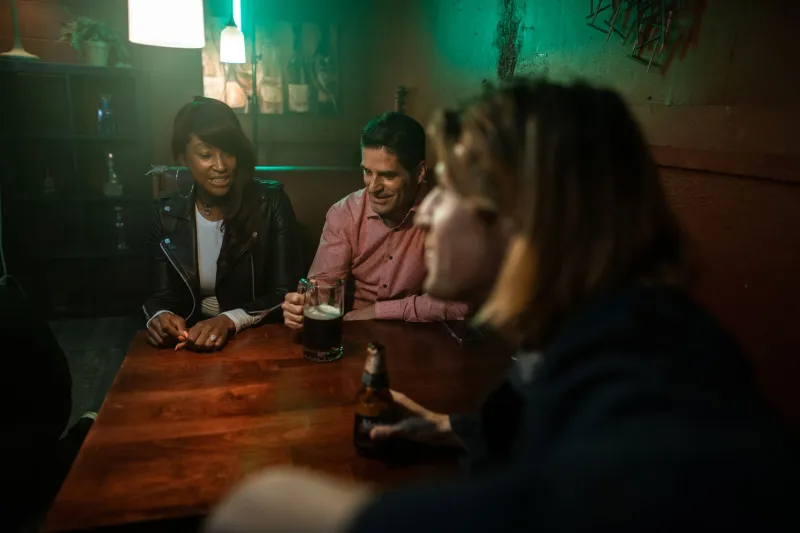
On a damp Tuesday in Leeds, the back room of a pub smells of chips, radiator dust and cheap biro ink. Six people are arguing about whether the 1994 Eurovision winner was a metaphor. Nobody is drunk. Nobody is trying to impress anyone. It is, unmistakably, the best night out in the city.
Welcome to the queer pub quiz: not the loudest item on the LGBTQ+ social calendar, not the one that gets the glossy photo spreads, but increasingly the one that people organise their week around. Across Manchester, Bristol, Glasgow, Cardiff, Sheffield and Brighton, back rooms are filling with teams of four to six, answering questions about camp telly, local queer lore and the kind of history that never made it into the school textbook. Entry is usually £2 or £3. The prize is often a bar tab, a novelty trophy or nothing at all. The real draw is stranger and softer than that.
The £2 ticket to somewhere
'People think a queer night out has to be a statement,' says Mara, who has hosted a Tuesday quiz at a pub in Leeds for the past four years. 'But a lot of us just want somewhere to sit with people who get it, where the stakes are low and the tea is hot. The quiz does that. It gives you a reason to be in the same room as other queer people without having to be interesting or dressed up or on.'
That low-stakes rhythm matters. A quiz is not a dating app, a dance floor or a networking event. You do not have to be witty for three hours straight. You do not have to shout over a bassline. You can be rubbish at geography and still be useful because you know every lyric from a forgotten lesbian sitcom. The format hands everyone a role: the history nerd, the telly obsessive, the one who can name a drag queen from a single eyebrow. It is social scaffolding, and it works.
It is also cheap. In a year when a round of drinks can easily hit £30, a quiz entry, a lime and soda and a packet of crisps is a night out for under a tenner. That is not a small thing. Queer spaces have always been shaped by money, and the quiz is one of the few weekly rituals that does not quietly assume everyone can afford the full cabaret.
Rounds that know their history
The best quizzes have a personality. A general knowledge round is fine, but the magic happens when the questions are built for the room. Hosts write rounds on LGBTQ+ history that go beyond the obvious: the forgotten activists, the court cases, the pubs that were meeting places before anyone called them venues. There are camp culture rounds on soap opera departures, cult films and diva feuds. There are local lore rounds that ask which canal towpath, which closed club, which chip shop was the site of a legendary night out in 2003.
'We always do a round called Hometown Heroes,' says Cal, who runs a monthly quiz in Bristol. 'It is about local queer people, local venues, local legends. People go mad for it. You can feel the room lean in. It is not just trivia. It is memory. It is saying: this happened here, and we were part of it.'
That intergenerational contact is one of the quiet radical things about the format. A quiz team might include a 22-year-old student and a 61-year-old who was clubbing in the same city decades earlier. They are not on a panel or a mentoring scheme. They are just trying to work out the missing word in a round about 1980s protest slogans. The conversation that follows is not forced. It is the point.
Sober, skint or simply rubbish at geography
The queer pub quiz is also one of the most sober-friendly nights we have. Plenty of venues now stock decent alcohol-free beer, and the social pressure to drink is noticeably lower when the main activity is staring at a question sheet. You can nurse a pint of squash for two hours and nobody will ask why. For people in recovery, for people who do not drink for religious or medical reasons, for people who simply cannot face a hangover, that matters.
It is not perfect. Some quizzes are too cliquey, some teams take it far too seriously, and there is always one person who argues with the host about the correct answer to a question about a 1997 chart hit. But the general atmosphere is less 'scene' and more 'front room'. You can turn up alone and be absorbed into a team before the first round ends. You can be terrible and still be welcomed back.
'My team started as three strangers and a spare chair,' says Nadia, a regular at a quiz in Manchester. 'Now we do birthdays together. We dog-sit for each other. One of us is 19 and one of us is 54. We would never have met otherwise. The quiz is just the excuse. The friendship is the actual event.'
How to find your table
Most queer pub quizzes are advertised on Instagram and in local listings, but the best ones travel by word of mouth. Ask at your local LGBTQ+ bookshop, community centre or bar. Look for the events that do not have a glossy poster but do have a recurring date and a host who clearly cares. Go once on your own if you have to. Sit near the back. Let the host know you are looking for a team. Most will happily point you towards a table with a spare seat.
Bring a pen. Bring a friend or do not. Bring the weirdly specific knowledge you have been carrying around since you were 13. The quiz does not care whether you are cool. It cares whether you can help with the tie-breaker.
And that, really, is the underrated magic of it. In a culture that still tends to measure queer nightlife by how loud or how late or how photogenic it is, the pub quiz offers something else: a weekly, low-cost, low-stakes ritual where the real prize is the table you get to sit at. The tie-breaker is tenderness. The answer, most weeks, is community.