Nobody's Judging the Second Verse: Inside the Queer Karaoke Nights Where Everyone Is the Headliner
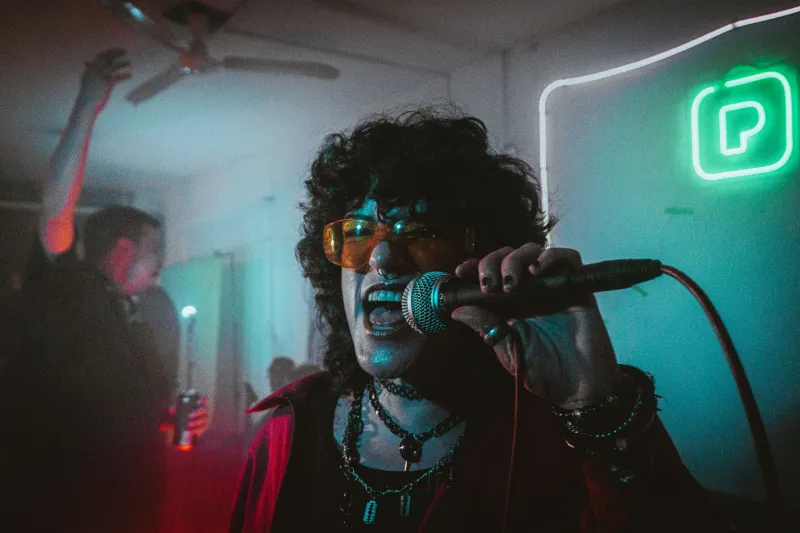
The first time I sang karaoke sober, I got the verses of 'Total Eclipse of the Heart' muddled, forgot which bit came after the key change, and briefly made eye contact with a stranger who was nodding along like a midwife. Nobody laughed at me. Somebody handed me a glass of lime and soda. A person I'd never met took the high harmony I hadn't asked for and absolutely needed. That, more than any headline DJ or warehouse rig, is the feeling a lot of us are chasing in 2026: a room where being slightly wrong is not just tolerated but kind of the point.
Queer karaoke nights have been quietly multiplying across the UK, and they don't look much like the mainstream version. There's less scoring, more swaying. Less 'wow, brave!' and more 'get in, we're doing the whole of ABBA's back catalogue together'. If the club night of the last decade was about being seen, this is about being heard — badly, loudly, and with an audience that has your back.
The booth is its own little country
Start in Manchester. Around the Northern Quarter and out towards Ancoats, private-room karaoke has become a genuine fixture of queer weeknights — the sort of thing you book for eight people and somehow leave with fourteen. The booths do a lot of the emotional labour: dim lighting, a door that closes, a screen that isn't facing the street. Nobody's watching you except the people you came with, which is exactly the permission some of us need to attempt 'Proud Mary' with our whole chest.
Glasgow does it with more swagger and better snacks. Up around the city centre and into the Southside, rooms get booked for birthdays, first dates, break-up recoveries and 'I just needed to scream' Tuesdays. There's a particular Glasgow energy to a private booth at 9pm: someone has already ordered chips, someone is doing a Christina Aguilera run they have no business attempting, and the whole thing is being filmed for a group chat that will never recover.
The booth model isn't a retreat from community — it's a doorway into it. Plenty of nights run a 'meet the room' half hour before the doors shut, so solo arrivals aren't left hovering by the fruit machine. If you've ever wanted to sing but dreaded the walk to the mic, this is the format that gets you there.
Sign up, don't show off
The best nights share a host with a clipboard and a very specific philosophy: consent first, chorus second. You put your name down, you say what you're singing, and — crucially — you say whether you want cheers, quiet, or a full-room backing choir. Nobody gets voluntold. Nobody gets dragged up for a 'surprise' duet because the host thinks it'll be funny.
That sounds small. It isn't. A lot of us have spent years in rooms where being the centre of attention was a risk rather than a gift, and a sign-up sheet with a few honest options respects that. The hosts I've watched are brilliant at reading the temperature: they'll hype a nervous first-timer into the mic and then step back, or bookend a really earnest ballad with something daft so nobody has to sit in the feeling too long.
The other rule you'll hear everywhere is 'cheer, don't score'. No Simon Cowell faces. No ironic slow clap. If someone's voice cracks on the bridge, the room fills in. It's a tiny piece of collective etiquette that turns a performance into a group activity — which, let's be honest, is the only reason karaoke ever worked in the first place.
A setlist with a conscience
Song curation is where these nights get genuinely clever. The good ones know that the queer canon is enormous and not all of it is a banger — and that sometimes the room needs 'Smalltown Boy' and sometimes it needs 'Murder on the Dancefloor' and sometimes it needs a Chappell Roan chorus sung by forty people who all mean it.
Hosts tend to build in a few things: a camp corner for the theatrical types, a pop-punk slot for the people who've been waiting all night, and a hard rule against anything that punches down. You won't find novelty tracks mocking accents or bodies. You will find a lot of women-who-rock, a suspicious amount of Kate Bush, and at least one person doing a spoken-word intro to a song that absolutely does not have a spoken-word intro.
And yes, there's usually a 'no phones on the mic' policy, or at least a phones-down minute. It's not technophobia. It's the recognition that a room full of people filming each other is a room full of people performing for somewhere else.
Soft lighting, softer rules
Bristol's back rooms and Leeds' pub function spaces have pushed the sober-friendly end of this scene furthest. Expect alcohol-free options that aren't an afterthought, a quiet corner for anyone who needs ten minutes out, and step-free access advertised up front rather than discovered on the night. Some nights run early slots — 7pm to 10pm — for people who love karaoke but hate 1am.
Look for the little signals on a listings page: 'no pressure to drink', 'low lighting', 'chill-out room', 'you can leave whenever'. Those aren't box-ticking. They're the difference between a night out and a night that costs you three days of recovery.
Where to start
If you're new to it, pick a private-booth night first — Manchester and Glasgow have the deepest benches — and go with two people rather than twelve. Book the early slot. Tell the host it's your first time; they will absolutely look after you. In Bristol and Leeds, the pub back-room nights are usually the friendliest entry point, especially if you're going solo and sober.
Bring a song you know you can finish, and a backup for when the nerves hit. Learn the second verse of one ballad, just one, and you'll never be caught out again. And if a stranger takes the harmony you didn't ask for? Let them. That's the whole thing. That's the group hug.