Mic Check, Consent Check: The Queer Comedy Nights Making Laughter Feel Safe
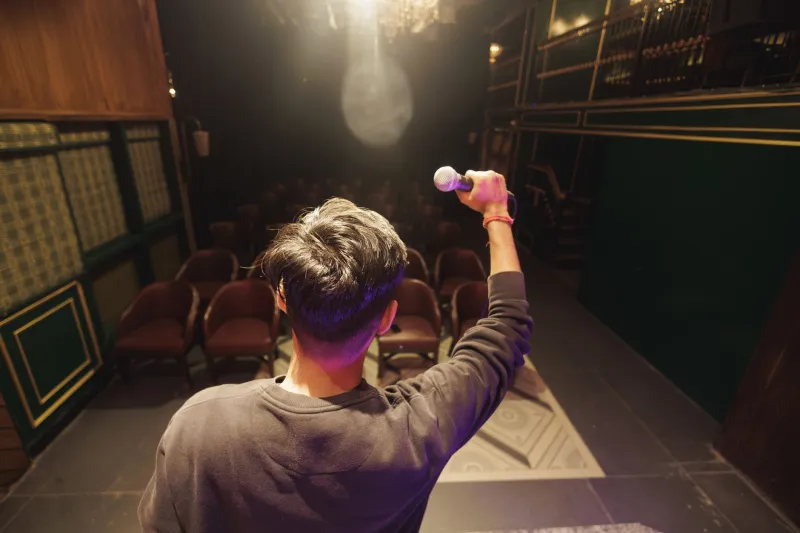
There is a particular sound a room makes when a joke lands and nobody has to flinch first. It is not the same as a big, showy laugh. It is looser. A little surprised. The kind of noise that happens when a comic says something genuinely odd and the audience decides, collectively, to go with it. On a Thursday night above a pub in south London, that is the sound filling the room at a queer comedy open mic. The carpet is sticky, the lighting is questionable, and the line-up is a beautiful mess of newbies, weirdos and one person doing a bit about queerbaiting a kettle. It is, frankly, the best night out I have had in weeks.
The room before the joke
Queer comedy nights are not a new invention. The UK has had queer comics, queer venues and queer audiences for as long as anyone has been bothering to put on a show. But something has shifted in 2026. The open mic has become a proper cultural space again: less a stepping stone to a Netflix special, more a weekly ritual of collective nerve. Organisers are not just booking acts and hoping for the best. They are building the room first.
That means house rules read out before the first set. Not a lecture, not a scolding, just a quick, friendly contract: no punching down, no heckling, no 'ironic' racism, transphobia or ableism dressed up as edgy comedy. Content warnings where they are useful. A host who actually hosts, rather than disappearing to the bar. Free water. A sign-up sheet that does not turn into a popularity contest. Small things, mostly. But small things are how safety gets built.
'People think safer spaces mean boring spaces,' says one organiser, who runs a monthly night in Manchester and asked not to be named because she is also a working comic. 'It is the opposite. If people are not braced for a slur, they can relax enough to laugh at something genuinely strange. The room gets braver because the baseline is kinder.'
Punching down is just lazy writing
The phrase 'punching down' gets rolled out a lot, but in comedy it usually means one thing: going for the easiest target in the room and pretending that is the same as having a point of view. Queer audiences are often treated as a punchline in mainstream comedy, and queer comics are often expected to explain themselves while doing it. The open mics doing it right are not interested in that trade.
'You can feel when a joke is built on contempt,' says a regular performer at a Bristol night. 'It might get a laugh, but it is a cheap laugh. It does not open anything up. The stuff I remember is the stuff that makes me go, oh, I have never heard it put like that before.'
That is why the best queer mics feel so experimental. You will get a tightly written five about dating apps, followed by someone doing a character piece about a haunted gym, followed by a comic who is clearly still figuring out the ending and knows it. Nobody is pretending this is Live at the Apollo. It is better than that. It is a lab, a social club and a pressure valve in one.
Community infrastructure with a microphone
Comedy is often described as a craft, a career or a coping mechanism. Less often is it described as infrastructure. But that is what these nights are: places where people meet, swap numbers, form writing groups, find flatmates, come out, come back after a bad week. The open mic is the excuse. The community is the point.
Some nights run pay-what-you-can tickets. Some have sober-friendly spaces and early start times. Some actively prioritise trans and non-binary performers, or Black and brown queer comics, not as a box-ticking exercise but because the default line-up still skews white, male and confident. The organisers are not pretending the scene is perfect. They are just doing the boring, necessary work of making it less predictable.
'It is not about being nice,' says one established comic who cut her teeth on queer open mics and now tours. 'It is about being accurate. If you want interesting comedy, you need interesting rooms. You need people who are not scared to fail. That does not happen by accident.'
Nights worth the train fare
The Queer Comedy Club in London has become a dependable home for queer stand-up, with regular open mic slots and mixed bills that let new material breathe. It is the kind of place where you can turn up alone and leave with three new Instagram follows and a recommendation for a good chips shop.
Manchester's Laughing Cows has been doing inclusive, women-led comedy for years, and its influence is still visible in the city's scene. The vibe is warm without being soft, and the line-ups are stubbornly good. In Glasgow and Edinburgh, meanwhile, queer comedy nights pop up in pubs, arts centres and the occasional bookshop, often with a scrappy, DIY energy that makes the big venues look a bit embarrassed.
Look out, too, for one-off queer comedy benefits and mixed bills at places like Soho Theatre and regional arts centres. They are not all open mics, but they are part of the same ecosystem. The open mic feeds the headline slot. The headline slot pays it forward.
The new comics doing the work
What sticks with you is not just the jokes. It is the posture of the people telling them. A new comic clutching a phone with notes, visibly terrified, then finding a laugh in the middle of a sentence and growing two inches taller. A more experienced act trying out a stupid, ambitious idea that might not work. A host who gently redirects a crowd that is getting too rowdy. These are small acts of courage, repeated weekly.
And the audiences are part of it. The best queer comedy crowds are not passive. They are generous, but they are not pushovers. They know the difference between a joke that challenges and a joke that just uses them as target practice. They laugh hard. They also let the silences sit when a set is not working. That is a skill, and it is one the scene is teaching in real time.
If you are going to one of these nights, do the usual things: buy a ticket if you can, put your phone away, do not heckle unless the host has explicitly invited it, and do not ask the comic to explain their gender on the way to the bar. Mostly, though, just be in the room. Laughter is not a cure for everything, but it is a pretty good way of reminding each other that we are still here, still weird, and still up for the next open mic.